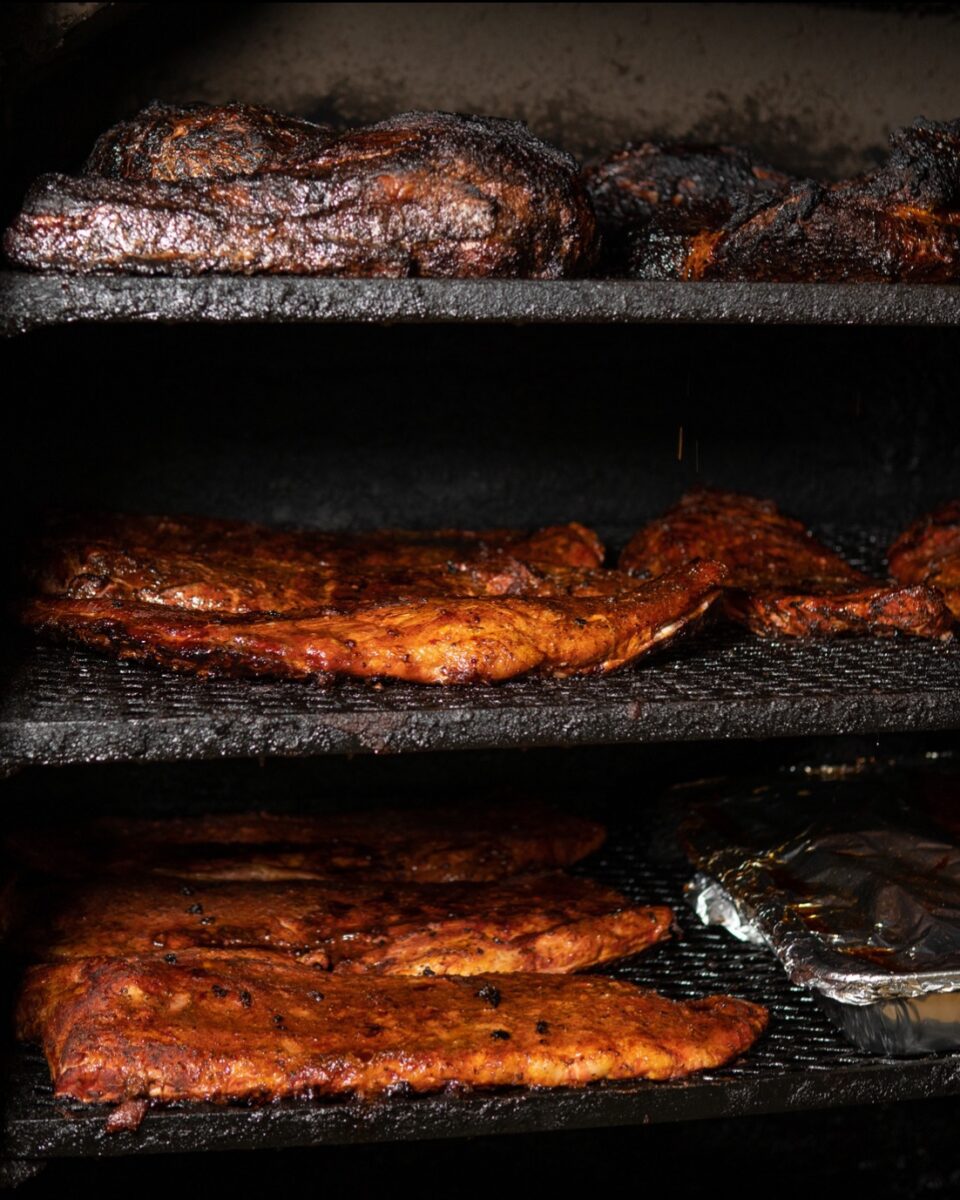
A gas grill uses propane or natural gas for direct heat cooking, while a wood smoker burns hardwood to produce indirect heat and live smoke over long periods. Gas grills are efficient and convenient for quick cooking, but they cannot replicate the smoke chemistry, bark formation, and collagen breakdown achieved through extended hardwood smoking. For authentic Texas barbecue—especially brisket and beef ribs—a wood smoker is the proper tool.
Barbecue equipment determines outcome. You can season meat carefully, trim it precisely, and monitor internal temperature closely, but if the heat source does not match the cooking goal, the final texture and flavor will change.
Gas grills and wood smokers are built for different purposes. One excels at speed, simplicity, and convenience. The other exists for patience, transformation, and the slow structural change that turns tough cuts into tender slices.
A gas grill burns propane or natural gas beneath metal grates. Burners produce controlled flames, and temperature is adjusted with knobs that increase or reduce fuel flow. It is quick, predictable, and easy to start, which is why it is a common everyday cooking tool.
Most gas grill cooking is direct heat. Even when you create “indirect zones,” the environment still behaves like a grill: relatively dry air, minimal combustion byproducts, and a clean-burning fuel source that does not naturally create continuous smoke.
That makes gas grills excellent for foods designed to cook fast. But traditional Texas barbecue is not fast cooking. Texas barbecue is low and slow craft, where time, airflow, and combustion shape the final result.
A wood smoker—especially an offset smoker—burns hardwood in a separate firebox. Heat and smoke travel indirectly through a cooking chamber before exiting through a stack. This creates a low, steady temperature environment designed for long cooks, typically in the 225–275°F range.
A wood smoker is not only a heat source. It is a flavor and texture engine. Hardwood combustion releases smoke particulates and aromatic compounds that adhere to the meat’s surface and interact with fat, seasoning, and moisture over time.
The fire must be actively managed. Airflow controls oxygen. Oxygen controls combustion quality. Clean combustion produces thin blue smoke that smells sweet and light. Poor airflow produces thicker, harsher smoke that can turn bark bitter and dull the meat’s natural flavor.
Gas is a clean-burning fuel. It produces heat efficiently, but it contributes very little flavor on its own. Any flavor from gas-grilled food comes mostly from browning, seasoning, and rendered drippings hitting hot surfaces.
Wood produces heat and flavor simultaneously. As oak or mesquite combusts, it releases aromatic compounds that attach to the meat’s surface and build depth gradually over hours. That slow accumulation is a defining feature of true barbecue.
You can add wood chips to a gas grill to imitate smoke, and it can help, but it does not create the same environment. Chips burn quickly and do not sustain the long, clean combustion cycle produced by split hardwood over many hours.
Bark—the dark crust on brisket and ribs—forms through smoke exposure, surface dehydration, rendered fat, seasoning interaction, and time. It is not simply “burnt seasoning.” It is the result of a controlled environment where the surface dries gradually while smoke compounds bond to it.
Gas grills struggle to produce true bark because they do not create continuous wood smoke or the long, low convection environment needed for slow crust development. Gas can brown a surface, but browning and bark are not the same thing.
Wood smokers create steady airflow that gently dehydrates the exterior while smoke adheres. Fat renders gradually and helps set the seasoning into a textured crust. That bark then protects the interior through the rest of the cook and delivers concentrated flavor in every bite.
Texas barbecue is built around collagen-rich cuts like brisket and beef ribs. These cuts are tough when raw because they contain strong connective tissue. To become tender, they need extended time at low heat so collagen can convert into gelatin and muscle fibers can relax rather than tighten into chew.
Gas grills are not designed for that duration or that style of cooking. While some can hold lower temperatures, they lack the smoke saturation and airflow design that define long-form barbecue. The environment remains relatively dry, and the smoke compounds that shape bark and flavor are not present in the same way.
Wood smokers are engineered for extended indirect heat. Thick steel or cast iron construction stabilizes temperature and reduces sudden swings, allowing connective tissue to break down slowly without drying out the surface.
Running a wood smoker teaches lessons gas equipment does not demand. As outdoor temperature drops, draft changes. A damper adjustment changes oxygen flow. Oxygen flow changes combustion. Combustion changes both heat consistency and smoke quality.
Adding a split of mesquite too aggressively can spike chamber heat and tighten the exterior early. Waiting too long can cool the coal bed and slow collagen conversion. Fire management becomes an active rhythm: small splits, steady airflow, and constant attention to clean combustion.
Gas does not require that awareness because it is controlled combustion by design. Wood is managed combustion, and that difference shows up in bark texture, smoke aroma, and tenderness.
Gas grills make sense when speed and simplicity are the priority. They are excellent for quick meals, high-heat searing, smaller gatherings, and places where live-fire smoking is not practical due to ventilation or time limitations.
There is nothing inherently wrong with gas. It is simply a different tool. The problem happens when people expect a gas grill to deliver bark, smoke depth, and collagen-driven tenderness that a wood smoker is designed to create.
If your goal is weeknight cooking, gas is efficient. If your goal is Texas barbecue, hardwood becomes essential.
Texas barbecue formed around hardwood availability—especially oak and mesquite—and the offset smoker evolved to handle large beef cuts over long cook times. The meat and method developed together.
Hardwood combustion creates the smoke compounds that build bark and the steady convection environment that supports long collagen conversion. That environment cannot be fully recreated with gas burners because the smoke is not continuous and the combustion is not the same.
At Abbey’s, briskets and pork shoulders are smoked for 18–24 hours over green oak and mesquite in hand-built cast iron smokers brought from Texas. The goal is clean fire, controlled airflow, and patience built into every cook cycle.
Texas barbecue is built on live fire. Long before modern convenience equipment existed, pitmasters learned that hardwood smoke and steady airflow were the foundation of real brisket and ribs.
Gas grills excel at grilling, but Texas barbecue is not grilling. It is slow transformation—fat rendering, collagen conversion, and bark development over hours of clean combustion.
At Abbey’s Real Texas BBQ, the process stays rooted in tradition: hardwood fire, disciplined airflow control, and long cook cycles that produce true Texas texture and flavor.
Gas grills are practical for everyday meals, but wood smokers are built for barbecue. If your goal is true Texas brisket—peppered bark, rendered fat, and deep oak aroma—hardwood is essential. The fire shapes the meat, and the method defines the result.
At Abbey’s Real Texas BBQ, briskets and pork shoulders are smoked 18–24 hours over green oak and mesquite in hand-built cast iron smokers brought from Texas. The process relies on steady airflow, live fire, and patient cook cycles, not gas burners.
📍 Location: 6904 Miramar Road, San Diego
Serving guests from Mira Mesa, University City, and La Jolla


